Dock Bumper Types: What Each One Is, and How Deep It Can Be
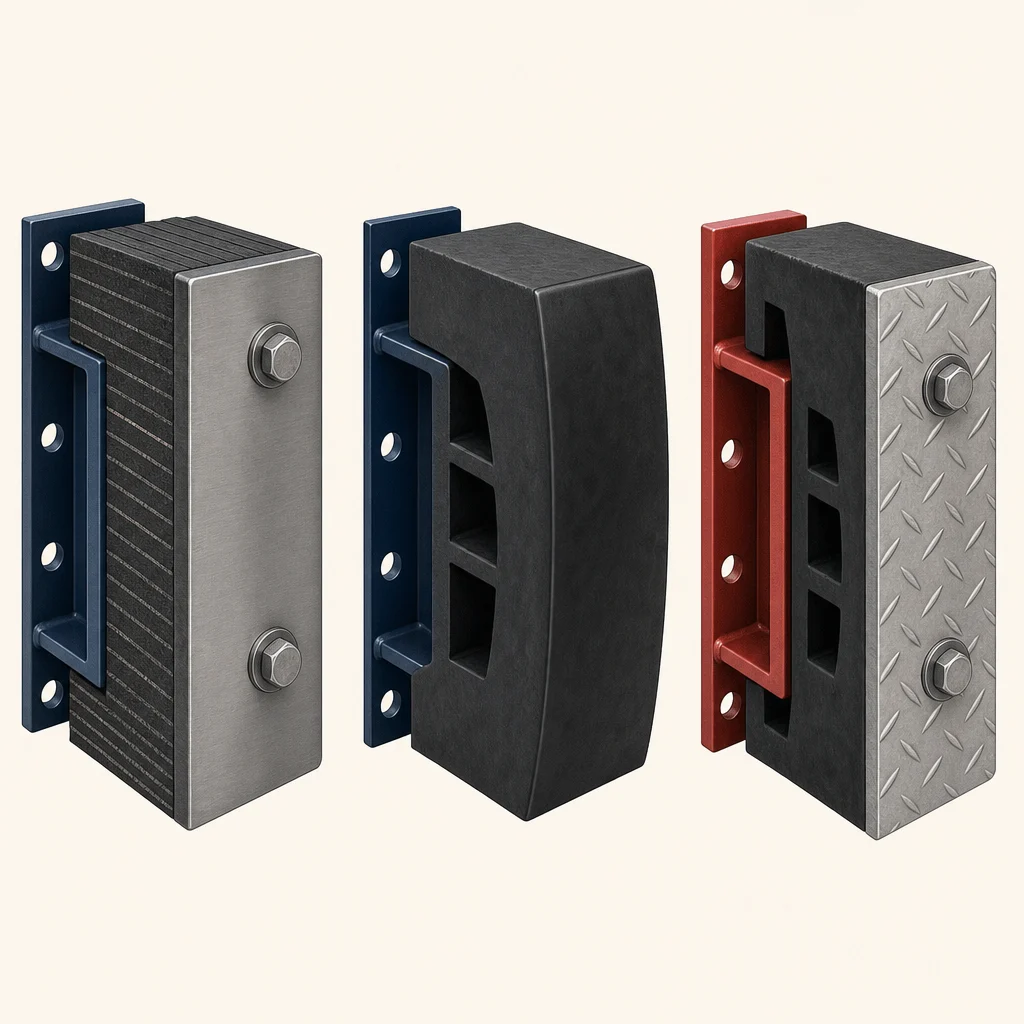
Illustrative comparison of three cited dock-bumper construction families. The article and its tables distinguish published specifications from independent calculations and performance claims.
What do the dock bumper types data show?
A 4½-inch rubber pad does not necessarily mean 4½ inches of bumper projection: Durable publishes 5¼ inches overall for that steel-faced configuration—a ¾-inch difference. Its catalog separates the pad, face plate and assembly dimensions; the comparison below preserves those distinctions rather than treating them as interchangeable. Source: Durable Corporation; checked September 12, 2026. 1
-
Durable's 4½-inch pad configuration projects 5¼ inches overall: ¾ inch beyond the pad thickness. Subtracting its ⅜-inch face plate still leaves ⅜ inch not explained by those two thickness fields; the same remainder appears on the published 6-inch and 9-inch pad configurations. Source: Durable Corporation catalog; calculation and verification September 12, 2026. 1
-
The 117-record model census contains 14 distinct published projection/thickness values, from 1½ to 12 inches, across three manufacturers. It comprises 103 Durable catalog records, 10 Vestil models and four Blue Giant models, including historical catalog entries—not 117 confirmed currently available products. Source: Omaha Dock Door Repair Research compilation; September 12, 2026. 1 5 7 19
-
Durable publishes a 5-year warranty for its standard laminated family; Rite-Hite publishes a 2-year limited warranty for its laminated family. These are different manufacturers' commitments within the same broad construction class, not identical products or measured lifespans. Sources: Durable Corporation and Rite-Hite; checked September 12, 2026. 1 4
-
The reviewed warranty statements extend from an explicit extra-thick-family exclusion at Durable to a 10-year limited term on Rite-Hite's DokSaver. DokSaver is an enclosed steel assembly containing rubber slats; the exclusion is not a zero-year service-life measurement. Sources: Durable Corporation and Rite-Hite; checked September 12, 2026. 1 4 31
-
A hypothetical 16-inch effective horizontal reach minus 12 inches of total projection leaves 4 inches of overlap, before any trailer-floor setback. A nominal 16-inch lip is not automatically 16 inches of usable reach: Hörmann documents a hinge-related reduction of approximately 3 inches. Source: Hörmann; illustrative calculation checked September 12, 2026—not a compliance determination. 14
-
The cited steel-faced families use ⅜-inch face plates at Durable and Rite-Hite and ⅝-inch protection at Blue Giant—a 66.7% thickness difference. That is a comparison of specified thickness, not a wear-life or impact-performance ranking. Sources: the three manufacturers; checked September 12, 2026. 3 4 5
-
Vestil lists two steel-faced molded-rubber models, B-516-SF and B-818-SF, with 2½-inch projection fields. The B-516-SF description separately prints 2⅝ inches; both values are retained in the dimension audit. Source: Vestil Manufacturing; checked September 12, 2026. 7
-
Of 12 selected performance-claim records from seven websites, 10 passages name no test method; two Durable catalog entries print ASTM designations. Those two designations are not complete test reports, and the audit includes two historical Cisco article passages available in the search index rather than at the current redirected URL. Source: Omaha Dock Door Repair Research claims audit; checked September 12, 2026. 1 10 12 13 16 17 18
-
Rite-Hite prints 75,000 pounds alongside 168 kN for DokSaver, but 75,000 lbf converts to approximately 334 kN. Conversely, 168 kN is approximately 37,800 lbf; the page does not resolve which force value is intended. Sources: Rite-Hite and NIST unit conversions; checked September 12, 2026. 4 15
-
A hypothetical moving mass of 40,000 lbm at 4 mph has approximately 21,395 ft-lbf of kinetic energy. Assigning that energy to a 0.75-inch stopping displacement gives twice the average resisting force of a 1.5-inch displacement; neither distance is a verified bumper compression stroke. Source: Omaha Dock Door Repair Research calculation using NIST conversions; September 12, 2026. 15
-
Blue Giant's BG610-14SF model row pairs 6 inches with 162 mm; the exact conversion is 152.4 mm. The same page separately prints 152 mm for the nominal 6-inch projection. Sources: Blue Giant and NIST; checked September 12, 2026. 5 15
-
Four of Vestil's 10 specialty molded model descriptions contain a smallest dimension differing by ⅛ inch from the separate projection field. The description strings also put that smallest value in different positions; the manufacturer labels its measurements approximate. Source: Vestil Manufacturing; checked September 12, 2026. 7
-
Durable's catalog lists durometer 80 ±5 for molded bumpers and 70 ±5 for extruded bumpers, without a test temperature in those specification blocks. These are manufacturer-published material values, not this publication's measurements or a cold-weather product ranking. Source: Durable Corporation; checked September 12, 2026. 1
-
Three Ideal Warehouse listings with 16 × 10-inch face dimensions advertise “as low as” prices of $78.95, $169.95 and $269.95—a 3.42-fold price range. Their listed projections differ, and the lowest-price listing itself conflicts between a 6-inch title and a 6½-inch attribute. Source: Global Industrial; captured September 12, 2026. 12
-
Omaha Eppley Airfield's 1991–2020 normals show 134.4 days per year with a minimum at or below 32 °F and 40.2 days with a maximum at or below 32 °F. These are one station's long-term averages, not a forecast or countywide measurements. Source: NOAA NCEI, station USW00014942; verified September 12, 2026. 26
By Omaha Dock Door Repair · Last verified: September 12, 2026
The phrase “four-inch bumper” describes one point in a much wider published range. We compared model records, family specifications, warranty statements and the dimensions that determine how a bumper fits a loading dock. The full comparison separates 14 values in the 117-record model census from 17 values in the broader family-inclusive projection reference; it does not mix the two denominators.
This page covers loading dock bumpers on commercial truck docks. It is not about boat dock fenders. The tables compare documentation, not physically tested products, and distinguish historical catalog specifications from current availability.
Where are the comparisons and source records?
The sections below separate bumper construction from projection, dimensions, warranty and published performance claims. Each section, numbered table and opening finding has a stable anchor; the downloadable records retain source URLs and verification dates.
Jump links: The seven comparison groups · Projection budget · What the type name does not tell you · Warranties · Steel and structure · Reading the dimensions · Impact force · Claims audit · Mounting and layout · Prices · Standards · Wear and replacement · Cold weather and Nebraska · Methodology · Limitations · Figures we could not verify · Download the data · Attribution details · FAQ · Sources
What are the main dock bumper types?
The main names describe laminated, molded and extruded bodies; exposed rubber, steel or polymer faces; and fixed, floating, sliding or adjustable arrangements. Those labels overlap: steel-faced bumpers can have either laminated or molded rubber behind the plate. The differences that matter are what the body is made of, what the contact surface is made of, and whether anything moves—separate questions that a single type name can collapse into one. 1 4 7
The seven comparison groups
The seven rows below are this publication's organizing scheme, not seven mutually exclusive constructions defined by an industry standard. The loop design is a particular steel-faced laminated arrangement; an enclosed steel assembly can still contain rubber. Roller and sliding examples follow the table rather than being mistaken for another rubber material.
Source: Durable Corporation catalog and Dura-Soft status page; Rite-Hite product page and full-line brochure; Blue Giant steel-faced page; Vestil specialty molded chart; Permatech steel-face page. All checked September 12, 2026. Compilation: Omaha Dock Door Repair Research. ★ verifies the published statement, not independent product performance. 1 4 5 7 9 19 31
Laminated bumpers are additionally documented in extra-length and extra-thick configurations. Durable's extra-length table reaches 10 ft 3 in between horizontal bolt-hole centers, with the corresponding overall assembly dimension reaching 10 ft 5 in. Extra-thick examples in the cited Durable and Rite-Hite descriptions include 9, 10, 10½ and 12 in. Those are dimensions within a construction class, not separate materials. 1 4
Roller and sliding bumpers are different mechanisms. US Patent 10,294,048 describes roller elements that rotate with vehicle movement and include an impact-absorbing member. Nylacast's Buffalo Dynamic Defender instead describes a nylon sliding element that moves with the vehicle; a patent disclosure is not a stock catalog or proof of tested service life. Neither example should be folded into the 117-record model denominator. 27 28
The historical designation matters especially for Dura-Soft. Its catalog remains useful for explaining the loop geometry, but its manufacturer's product page explicitly says the product is no longer available. Retaining those 11 catalog rows documents a design; it does not turn them into current purchasing options. 19
The comparison therefore answers “what is this design?” before “is this exact configuration suitable here?” The second question requires the current model drawing, the dock interface and the manufacturer's application requirements. A type label alone does not supply those missing dimensions.
Data for the model comparison: 117-record model census (CSV) · Combined dataset (JSON).
How much projection can a dock bumper actually have?
Projection—how far the installed bumper assembly stands out from the dock face—uses part of the dock leveler's available horizontal reach. But nominal lip length is not automatically usable reach: Hörmann lists a 16-inch standard lip and an 18-inch option while explaining that the hinge reduces bridging by approximately 3 inches. There is no defensible universal 12-inch bumper ceiling from subtracting a claimed minimum overlap from the nominal lip alone. 14
This is the arithmetic that the phrase “thicker is safer” hides. Deeper bumpers increase the separation between the trailer contact point and the building. They can also reduce the overlap available for the bridge into the trailer, so bumper projection, leveler geometry and the trailer rear structure have to be considered together. Blue Giant's planning guidance treats that interface explicitly. 37
For the table below, R means effective horizontal reach measured from the dock face, P means total installed projection, and S means the horizontal setback from the bumper-contact plane to the usable trailer floor edge. The illustrative overlap is R − P − S. Table 2 sets S to zero and uses hypothetical effective reaches of 16, 18 and 20 inches; it does not assert that a nominal lip of any of those lengths supplies that reach.
Source: projection examples from Durable, Vestil, Blue Giant, Rite-Hite and Permatech; Blue Giant build-out dimensions; reach-versus-lip distinction from Hörmann. Calculation: Omaha Dock Door Repair Research, September 12, 2026. The 14-inch row is an arithmetic assembly hypothesis, not a verified manufacturer-approved combination. No row determines compliance. 1 4 5 6 7 9 14
The first 17 rows collect published projection or profile-thickness values from both model tables and broader family descriptions. Only 14 of those values occur in the 117-record model census: 8 inches is added by Permatech's family range, 9¾ inches by Durable's steel-face description, and 10 inches by Rite-Hite's extra-thick range. The 14-inch illustration is separate from both counts. This separation keeps a useful reference range from becoming a false statistic about the model sample.
Why 12 inches is an example, not a universal limit
Durable and Rite-Hite both publish 12-inch extra-thick examples. In the table's hypothetical geometry, 16 inches of effective reach minus 12 inches of projection leaves 4 inches of overlap. That subtraction does not establish why the manufacturers chose a size, whether that overlap is sufficient, or what any particular nominal lip will reach. 1 4
A trailer's rear step or other structure can place its usable floor edge farther forward than its bumper-contact plane. In the simple formula, that is a positive S: another subtraction from the available overlap. No universal refrigerated-trailer allowance is supplied here, because the cited sources do not establish one for every trailer and dock configuration.
Build-outs and risers also need different columns. Blue Giant publishes build-out projections of 2, 4, 6 and 8 inches and riser extensions of 4, 6, 8, 10 and 12 inches for higher impact positions. Build-outs add horizontal stand-off; risers address height. The riser figures must not be added to a horizontal projection budget as though they were interchangeable accessories. 6 36
A 6-inch bumper and an 8-inch build-out sum to 14 inches arithmetically. Whether those particular components can form an approved assembly, where the contact face lands, and what the leveler must reach are separate questions. The table does not approve a stack or prescribe an anchor, bracket or replacement lip.
When additional effective reach changes the answer
The right-hand columns show what more effective horizontal reach recovers: adding 2 inches to R adds 2 inches to the calculated overlap, and adding 4 inches adds 4 inches. A 12-inch projection at an 18-inch effective reach produces 6 inches of illustrative overlap before setback, while a 14-inch projection produces 4 inches. Those are properties of the model, not measurements of a named leveler.
Hörmann's documentation distinguishes nominal lip options from effective bridging and describes an option supplying a 20-inch effective reach. That is precisely why the relevant dimension should come from the actual equipment documentation rather than from a generic subtraction using a catalog lip length. 14
Koke's own guidance also warns that increasing bumper projection reduces the leveler lip's reach onto the trailer bed. That is the trade-off in one sentence, and it is the reason projection is a budget rather than a preference. The final comparison belongs in the project geometry, with the manufacturer's required engagement and actual operating range. 11
What does the type name not tell you?
A dock bumper label can mix four separate attributes: what the body is made of, what the contact face is made of, whether anything moves, and what shape it is. “Steel-faced” describes the second, not necessarily the first: Vestil publishes B-516-SF and B-818-SF with molded rubber cores, while Durable, Rite-Hite and Blue Giant document steel-faced laminated families. The phrase alone therefore does not identify the construction behind the plate. 1 4 5 7
We separate the four attributes because the documented examples combine them differently. A model can be molded, steel-faced and rectangular at the same time; treating those labels as alternatives loses information rather than simplifying the comparison.
Source: Durable, Rite-Hite, Blue Giant, Vestil, Stertil and Nylacast descriptions, checked September 12, 2026. Classification framework: Omaha Dock Door Repair Research; not an industry standard. 1 4 5 6 7 28 29 36
Enclosed steel box is not a synonym for rubber-free. Rite-Hite's DokSaver brochure labels rubber slats inside an enclosed steel assembly, with a ½-inch face and a ¼-inch back plate. The product page describes eliminating steel rods; that statement should not be expanded into eliminating the rubber. 31
Stertil's GB brochure dated December 2021 documents polyethylene bumpers in a console frame: a fixed PE model and a height-adjustable PE-M. The PE-M description gives 248 mm of vertical reach above its mounting position. That reach is not automatically a sliding stroke, and these international examples do not establish current US availability. 29
The polymer name needs the same discipline. UHMW polyethylene, ordinary product descriptions identifying PE, nylon, and an unspecified plastic face are not one verified material specification. The page records the term actually published for each example, rather than filling an unknown field with the most familiar polymer name. 1 7 28 29
Likewise, an orientation label does not settle a movement question. A tall fixed contact surface, a floating plate and a sliding mechanism can all address a vertically moving vehicle in different ways. Their descriptions should remain separate until an actual manufacturer's drawing and movement specification establish what the particular assembly does.
How long is a dock bumper warrantied for?
The reviewed family statements extend from an explicit warranty exclusion for Durable's extra-thick bumpers to a 10-year limited warranty for Rite-Hite's DokSaver. Within the broad laminated-rubber class, Durable states 5 years for its standard family and Rite-Hite states 2 years limited. Warranty is a manufacturer's commitment under its terms, not a measurement of how long a bumper will last. 1 4
The useful comparison is not “how many years does laminated rubber last?” It is “what duration does this manufacturer actually state for this family?” An unstated term is not zero, and a family-specific exception must not disappear behind a general warranty line.
Source: Durable catalog and current extra-length/Dura-Soft pages; Rite-Hite loading dock bumpers page; Blue Giant steel-faced and plain-laminated pages. Checked September 12, 2026. A dash means no corresponding family entry was recorded in this comparison; it does not assert the manufacturer makes no such product. 1 4 5 19 32 38
Two findings worth pulling out of that grid.
The laminated gap. Durable and Rite-Hite describe reinforced rubber slats or pads supported between steel members using ¾-inch rods, yet publish 5-year and 2-year terms for their respective standard laminated families. A buyer comparing “laminated bumpers” without reading the warranty line is comparing two different commitments. That observation does not mean the products are identical or their coverage conditions match. 1 4
The extra-thick difference. Durable attributes its explicit extra-thick exclusion to specialty applications; Rite-Hite publishes a 2-year term for its extra-thick family. Both statements can be true. They describe different manufacturers' policies, not opposing physical results from a shared test. 1 4
Durable's catalog also includes general warranty language and a discussion of pro-rata replacement. Those general statements and the family-specific exclusion should remain visible together; this table is not a legal interpretation of every possible defect claim or other right. The extra-length family is left without a duration because the reviewed family material did not independently state one. 1 32
Finally, a historical warranty statement belongs to its historical document. Dura-Soft's five-year catalog language remains part of the design record, while the current manufacturer page says the product is no longer available. It is not presented here as a new offer of five years' coverage on an order placed today. 19
What is a dock bumper actually made of?
The body, contact face and supporting steel need separate specification fields. The reviewed rubber descriptions include recycled tire pads and one-piece reinforced molded rubber, but the steel dimensions differ between manufacturers and even between families from the same manufacturer. Those dimensions identify components; they do not by themselves establish impact capacity, abrasion life or the stronger product. 1 4 5
Source: Durable catalog; Rite-Hite product page and cutaway brochure; Blue Giant steel-faced and plain-laminated pages. Checked September 12, 2026. Values apply to the identified components and families, not to every product made by each company. 1 4 5 31 38
The face-plate row is the straightforward arithmetic: Blue Giant's cited ⅝-inch specification is 66.7% thicker than the ⅜-inch plates documented by Durable and Rite-Hite. That calculation says how much thicker the stated component is. No matched wear test in the reviewed documents converts it into 66.7% longer life. 3 4 5
The angle row shows why family scope matters. Rite-Hite's ⅜-inch laminated-family angle is 50% thicker than a ¼-inch angle, but Blue Giant also identifies ⅜-inch angles on its plain-laminated page. Assigning one angle thickness to an entire brand would flatten that distinction. Comparing a component from one family with another family's warranty would then compound the error. 4 5 38
Rubber properties, and the missing test temperature
Durable's catalog publishes material-property values for its molded and extruded families. The molded block states durometer 80 ±5 and 95% impact recovery, with “ASTM 1170” printed beside the latter; the extruded block states durometer 70 ±5, tensile strength 1,850 psi, elongation 220%, tear strength 229 lb/in with “ASTM 624,” and 75% impact resistance with “ASTM 2632.” These are transcribed manufacturer statements, not tests performed by this publication. 1
Two qualifications belong with those numbers. First, the cited specification blocks do not state a test temperature or provide complete reports identifying specimens and procedures. ASTM's own D2632 description identifies a vertical-rebound resilience method for solid rubber, warns about sensitivity to test conditions, and does not make the result a direct measure of end-use bumper performance. 33
Second, the molded catalog page prints two different tensile ranges: 950–1,505 psi in the material description and 950–1,050 psi in the specification block. We report both figures as published and do not pick one. Nor do we silently replace the printed “ASTM 1170” with D2632 merely because D2632 is a recognizable rubber-resilience method. The unresolved designation belongs beside the claimed recovery value. 1
An impact-recovery figure, a durometer value and a claim about absorbing a percentage of truck impact are not interchangeable measurements. The claim audit below separates those statements instead of plotting them on one misleading performance scale.
How do you read a dock bumper's dimensions?
Carefully, because rubber-pad thickness, overall projection and a three-number description string are not interchangeable. Durable's steel-face specifications distinguish a 4½-inch pad from a 5¼-inch overall projection; Vestil supplies a separate projection field alongside description strings that sometimes differ. The correct comparison preserves each label rather than choosing the most convenient number. 1 7
The clearest example is Durable's steel-face line. A 4½-inch pad plus a ⅜-inch plate adds to 4⅞ inches, while the published overall projection is 5¼ inches. The same ⅜-inch remainder appears on the 6-inch pad configuration, published at 6¾ inches, and the 9-inch pad configuration, published at 9¾ inches. This demonstrates that adding those two thicknesses does not reproduce the whole assembly; it does not establish an error in the overall dimension or identify the remaining component geometry. 1
Source: Durable catalog, Steel-Face and Dura-Soft specification blocks; checked September 12, 2026. Addition and subtraction: Omaha Dock Door Repair Research. Dura-Soft is a historical catalog entry; its product page now says no longer available. 1 19
The loop-design row illustrates another distinction. Its stated flex is a movement allowance, whereas the 5½-inch figure is a published overall dimension. A movement allowance cannot be allocated as a static piece of the assembly without a drawing establishing that relationship. The table therefore retains the 1⅛-inch arithmetic remainder without declaring that the flex “occupies” part of it.
The dimension-string problem
Vestil publishes an explicitly labeled Projection (in.) field for each of the 10 specialty molded models alongside a three-number description string. Four strings contain a smallest value that differs from that projection field by ⅛ inch. Vestil also says the dimensions are approximate; the comparison records the mismatch without deciding whether it represents rounding, nominal sizing, a revision or an error. 7
Source: Vestil Manufacturing, Specialty Molded Dock Bumpers model chart, checked September 12, 2026. The smallest-value comparison is an arithmetic observation, not an independently measured projection or an assignment of axes to every description. Comparison: Omaha Dock Door Repair Research. 7
Note the two bolded steel-face rows: B-516-SF places its smallest dimension first, while B-818-SF places it last. An unlabeled string cannot be assumed to run width × height × projection. B-516-SF's separately labeled projection is 2½ inches, but its description includes 2⅝ inches; both belong in a defensible record. 7
The catalog's other dimensions need equally careful labels. In Durable's laminated-family drawings, C is horizontal bolt-hole-center spacing, while other fields identify rubber length and overall assembly length. A download that renamed C simply “length” would invite readers to use bolt spacing as the overall width. The corrected records therefore preserve C as a bolt-center dimension. 1
One extra-thick row remains internally inconsistent: B10520-11 prints C = 14 inches, E = 7 inches and F = 13 inches in the catalog. We retain the published fields rather than deriving a plausible replacement from the model name. That row is evidence of a documentation conflict, not an order-ready dimensional specification. 1
A published conversion that does not convert
Blue Giant lists four steel-faced models with dual units. For BG610-14SF, the row prints 6 × 10 × 14 inches / 162 × 254 × 356 mm, but six inches converts exactly to 152.4 mm. The same page's specification line states the standard 6-inch projection as 152 mm. The 162 mm model value therefore does not reconcile with either the exact conversion or the page's own rounded projection statement. 5 15
The other three model rows' projection conversions are consistent with rounding to whole millimeters. We retain the conflict because 162 mm is a plausible-looking fabrication dimension, and silently changing it would conceal the fact that the manufacturer's published fields disagree. The dataset separately records the inch dimension, the printed millimeter string and the explanatory note.
Catalog weights are not automatically current webpage weights
The source distinction matters for weight as well. For example, Durable's catalog lists B4510-36SF at 72 lb, while its current steel-face page lists the corresponding B4510-36-SF at 117 lb. Other reviewed steel-face rows also differ between those two publications. The catalog values remain labeled as catalog values; directly checked webpage values are stored in separate fields rather than overwriting the original transcription. 1 3
Vestil's chart has another labeling issue: the column is headed net weight, while the accompanying note calls the weights approximate shipping weights. The download preserves the numeric value with that qualification instead of inventing a net-versus-shipping distinction the page does not resolve. Neither set of weights is used to rank bumper performance. 7
How much force does a trailer put on a dock bumper?
Mass and speed determine kinetic energy, but not a unique impact force. A hypothetical moving mass of 40,000 lbm at 4 mph carries approximately 21,395 ft-lbf, or 29,007 joules, while the average resisting force in a work-energy model also depends on stopping displacement and on how much energy is assigned to that resistance. A bumper's exposed rubber thickness is not a verified compression stroke. 15
We ran the arithmetic in both directions. The first two rows treat the published force magnitudes of 100,000 and 150,000 pounds as assumed average forces solely to calculate conditional stopping distances. Chalfant's 100,000-pound statement does not supply the 40,000-lbm/4-mph input pair; those inputs are imposed by this comparison, not attributed to Chalfant. The Cisco passage does give that pair, but does not provide a test or stopping-distance protocol. 10 16
Every input is shown so the calculation can be checked. The last four rows are sensitivity cases, not measurements of new or worn bumpers, and the double-mass row is a mathematical comparison rather than a statement about a vehicle's legal gross weight.
Source: force magnitudes discussed by Chalfant and in Cisco's historical publisher article; unit conversions from NIST. Calculations: Omaha Dock Door Repair Research, September 12, 2026. The model assigns the displayed kinetic energy to resistance over the displayed displacement; it does not predict peak force, approved operating speed, building load or a particular bumper's response. 10 15 16
Two things follow from the calculation—not from an assumed wear test.
Halving the assumed stopping displacement doubles the calculated average force. For the same energy, changing d from 1.5 inches to 0.75 inch changes E/d from approximately 171,158 lbf to 342,316 lbf: a 100% increase, not a 50% increase. That relationship is exact within the model. It does not mean that wearing away half of the exposed rubber halves the actual stopping displacement. The missing force–displacement behavior cannot be supplied by a photograph or by a nominal thickness. 15
Halving speed quarters the kinetic energy. Holding the assumed displacement at 1.5 inches while changing speed from 4 mph to 2 mph reduces the displayed energy and average resisting force to one quarter. Changing both speed and displacement creates a different comparison, which is why the table specifies both rather than attaching one force value to the phrase “a backing truck.” This is an illustration of the square-of-speed relationship, not an operating-speed recommendation.
The reviewed force claims do not supply enough information to reproduce a physical test. That is different from saying they were never measured. The source passages do not establish whether their force values are peaks, displacement averages or another quantity, nor a documented load path and test configuration. We report the conditional arithmetic without asserting an undisclosed test history. 10 16
For reproducibility, the calculation uses 1 lbm = 0.45359237 kg, 1 mph = 0.44704 m/s, 1 inch = 0.0254 m, and standard gravity of 9.80665 m/s² to convert pounds-force. It evaluates KE = ½mv² and F̄ = KE/d in consistent units, retaining more precision in the downloads than in the rounded table. The average here is over stopping displacement; it is not a measured time-average force. 15
A published design statement, and its unit problem
Rite-Hite states that DokSaver is designed to withstand “75,000 lbs (168 kN) of pressure.” Those force units do not convert to one another: 75,000 lbf is approximately 334 kN, while 168 kN is approximately 37,800 lbf. The word pressure is also not dimensionally precise here because the statement gives no force-per-area unit. We report the printed pair and do not select the intended value. 4 15
This is a separately reviewed product-family statement, not a numeric rating attached to one of the 117 sampled model rows. It cannot be compared directly with Table 8 to declare the product adequate or inadequate: the product statement and the calculation do not establish the same test conditions, force definition or load path. A numerical discrepancy is worth exposing; an unsupported safety verdict is not.
Do published performance claims hold up?
The selected audit contains 12 claim records from seven websites, not a census of every claim in the market. Ten reviewed passages name no test method; two Durable material-property entries print ASTM designation strings but do not provide complete reproducible test reports. These statements mix impact-force claims, material recovery, resilience and comparative wear, so their percentages must not be treated as one measured performance scale. 1 10 12 13 16 17 18
The source is used for a narrow purpose here: it establishes what its publisher says, not that the claimed absorption or wear result is independently proven. That distinction also prevents one supplier's material test from being used to validate another publisher's assertion about a whole truck docking event.
Source: the original publisher materials listed in sources 1, 10, 12, 13, 16, 17 and 18; checked September 12, 2026. Cisco's two records are historical publisher text retrieved from the search index; direct access to the original article URL redirects to its blog index. Audit: Omaha Dock Door Repair Research.
The seven-site count is not a count of independent companies: the Overhead Door Company of the Meadowlands & NYC page identifies itself as a division of Loading Dock, Inc. Agreement between those sites is therefore not independent corroboration. 18
The absorption language includes values around 80% and 90–95%, but those figures do not identify a common test population, setup or denominator. The 75% extruded material value and the 95% molded recovery value are different statements again. There is no valid “best percentage” ranking in this table. 1 13
ASTM D2632 describes vertical rebound of solid rubber. Its publisher warns that resilience values depend on conditions and instrumentation and do not necessarily predict end-use performance. Even a correctly identified material method therefore does not turn a rebound percentage into a measured percentage of a trailer's kinetic energy absorbed by an installed dock bumper. 33
We are not saying these claims are false. We are saying that the reviewed passages do not provide the common methods and conditions necessary to check them against one another. The existence of two printed ASTM references is preserved rather than obscured by the incorrect blanket statement that none of the 12 records names a method.
The historical Cisco records have an additional access limitation. Their claim passages remain visible in the search index, but the direct article address no longer supplies the article during this verification pass. They are retained as historical statements with that status, not presented as current manufacturer technical specifications. The energy illustration does not rely on accepting their performance claims. 16
How are dock bumpers mounted and spaced?
Mounting and spacing depend on the bumper, dock structure and equipment interface; there is no universal layout derived from a type label. Durable's catalog supplies examples for its own bumpers, including a stated mounting position 1–2 inches below dock level and particular horizontal-spacing arrangements. Those examples are documentation references, not a substitute for current project drawings or an anchor design. 1
Anchoring into concrete, welding to steel and working around trailers are jobs for qualified installers. This section describes what the published guidance covers, not a sequence for doing that work. Dimensions tied to one manufacturer's drawing must remain tied to that drawing instead of being presented as general construction instructions.
Source: Durable catalog, selecting/installation sections; Vestil specialty molded model chart; Chalfant selection guidance. Checked September 12, 2026. This table preserves the application topics while leaving hazardous attachment design and installation to qualified professionals using the relevant documentation. 1 7 10
The air-ride row explains why bumper height and movement are separate specification questions. Chalfant's application guidance discusses vertical vehicle movement; Durable's steel-face description addresses friction associated with up-and-down movement. Neither source establishes a universal cumulative number of feet of scrubbing over a bumper's life. 3 10
Spacing also has to leave the rest of the dock equipment usable. A diagram showing clearance for one portable plate cannot establish the clearance required by every plate, vehicle restraint or trailer geometry. The same caution applies to a bracket that changes impact height: a riser is not automatically a horizontal build-out, and a hole accepting a certain bolt diameter is not proof that an arbitrary anchor of that diameter is adequate.
The reference value here is knowing which drawing and which field to request or inspect—not extracting a few generic numbers and turning them into an installation recipe.
What do dock bumpers cost?
Seven sampled laminated-bumper listings with 4½-inch projection advertised “as low as” prices from $58.95 to $159.95 at Global Industrial on September 12, 2026. Three Ideal Warehouse listings with 16 × 10-inch face dimensions advertised $78.95, $169.95 and $269.95, but the lowest-price listing contains a 6-inch-versus-6½-inch projection conflict. These are advertised price observations at one seller, not a market average, confirmed single-unit checkout price or installed cost. 12
The quotation marks around “as low as” matter. That is the seller's price label, not a list-price field we independently established. Quantity conditions and final checkout totals were not priced as part of this comparison.
Source: Global Industrial category listings; exact SKUs and conflicting fields retained in the downloadable price census. Captured September 12, 2026. No tax, shipping, anchor or labor total was calculated. 12
The three 16 × 10-inch listings hold the displayed face dimensions and brand name constant, but they are different SKUs—not a controlled experiment varying only depth. The highest advertised price is 3.42 times the lowest, or approximately 242% higher, calculated as $269.95 ÷ $78.95 and the corresponding percentage increase. That is a defensible description of this listing set, not proof that projection alone caused the price difference.
The lowest-price Ideal listing, WB988773, illustrates the same source-integrity issue as the dimensional tables: its title says 6-inch projection, while the separate attribute says 6½ inches. Both values remain in the dataset. We do not calculate a confident percentage increase in depth from an unresolved starting dimension. 12
The $58.95 listing, WB988026, is labeled 14 × 9½ inches in the reviewed source. That face-size correction matters because a reader comparing prices by area would otherwise be using the wrong denominator. The table therefore keeps the SKU alongside the dimension and price rather than asking the reader to match similar-looking product names.
Nothing in this price sample establishes Omaha labor rates, installed replacement cost, or what a particular facility would pay after freight, accessories and quantity terms. Those would require a separate cost study with a different methodology.
What do standards require for dock bumpers?
The reviewed federal provisions regulate adjacent equipment and operations: dockboards in 29 CFR 1910.26, truck securing during powered-industrial-truck operations in 1910.178(k), and fall protection in 1910.28. Those specific provisions do not establish a universal dock-bumper material, projection or replacement percentage. That bounded finding is not an assertion that no other applicable rule, project requirement or manufacturer instruction can affect a dock installation. 23 24 30
The MH30 documents also have to be identified accurately. ANSI's listings describe MH30.1-2022 as addressing dock leveling devices, MH30.2-2022 as addressing portable dock leveling devices, and MH30.3-2022 as addressing vehicle restraining devices. The listings were reviewed for identity and scope; the full standards were not reviewed, so this page does not attribute an exact lip-engagement clause to them. 25 39 40
Source: current eCFR sections and the official ANSI MH30-series listings; checked September 12, 2026. For the MH30 standards, only published identity and scope are asserted. 20 21 22 23 24 25 39 40
The trailer-guard provisions are worth reading because their measurements have precise reference conditions. In 49 CFR 571.224 S5.1.2, the bottom of the guard's horizontal member must not exceed 560 mm above the ground under the specified vehicle configuration, subject to the stated rounded-corner provision. S5.1.3 generally limits the specified rear-surface position to no more than 305 mm forward of the defined rear-extremity plane, with its stated qualifications. Those values are approximately 22 and 12 inches; they are not bumper-height instructions. 21
Scope comes before geometry. The standard identifies covered trailers and semitrailers, exclusions, a defined rear extremity and vehicle conditions for the measurements. It does not establish that every rear impact guard will pass below every dock bumper, or that a bumper must contact a particular part of every trailer. Those conclusions require the actual vehicle and dock geometry.
A bumper is not a vehicle restraint. Providing a contact surface between a backing vehicle and a building is different from securing that vehicle against unintended movement during loading. Section 1910.26 addresses measures preventing vehicle movement while dockboards are in use under its conditions; section 1910.178(k) includes brakes and wheel-chock language for the stated operations. The complete applicable requirements and equipment instructions—not a bumper type name—govern those operations. 23 24
Fall-protection duties belong to their own provisions, including 1910.28. They should not be replaced by an assumption that installing an impact bumper protects an open dock edge or satisfies the duties governing workers at that edge. 30
When does a dock bumper need replacing?
The reviewed maintenance guidance includes a 50% wear recommendation from Loading Systems and, in Cisco's historical article, an example of roughly ¾ inch of exposed rubber remaining from an initial 1½ inches. Those are attributed maintenance recommendations, not a verified universal standard for every bumper design. The relevant model's instructions and a qualified assessment of the bumper, attachments and dock structure determine the practical replacement decision. 16 17
The geometry in that wear example needs an exact denominator. Half of an exposed rubber portion is not necessarily half of the whole bumper's projection, and neither is automatically half of its compressible stroke. A bumper can have steel, backing, brackets and other dimensions between the contact face and the wall.
Loading Systems also identifies damage such as cracking or deformation in its replacement discussion. The Cisco text discusses rubber damage and the condition of the frame, anchors, welds and concrete. These observations are useful as the scope of an inspection by qualified personnel; they are not instructions to approach an occupied dock, remove hardware or carry out a structural repair. 16 17
The claim attached to the wear guidance—that good bumpers absorb over 80% of impact while worn ones absorb less than 15%—appears in the reviewed Loading Systems material and the historical Cisco text. The passages do not publish a common test protocol supporting a direct comparison. Table 8 does not validate those percentages: its displacement values are hypothetical, and its inverse force relationship must not be relabeled as a measured wear penalty. 16 17
What can be stated arithmetically is narrower. If a contact face's projection decreases from 4½ inches to 3¾ inches while the rest of the assumed geometry stays fixed, stand-off decreases by ¾ inch. In the simplified overlap model, that would add ¾ inch to calculated reach beyond the contact plane. The lost ¾ inch is one sixth of the original 4½-inch projection—not half of it.
That arithmetic is not a reason to keep a damaged bumper in service to gain reach. It simply shows why changing contact geometry affects more than one part of the dock interface. Suitability cannot be inferred from a convenient extra fraction of an inch of apparent overlap.
The distinction among exposed material, overall stand-off and compression travel should survive every quotation from this section. Confusing them is the step that turns a useful maintenance example into an unsupported force calculation.
Why does Omaha's cold weather matter to bumper specifications?
Omaha Eppley Airfield's 1991–2020 normals show 40.2 days per year with a daily maximum at or below 32 °F, while Durable's cited durometer blocks give no test temperature. That combination establishes a local exposure question, not a measured cold-weather penalty for a particular bumper. ASTM's rubber-resilience guidance identifies temperature as a test consideration, so a room-temperature-looking number without stated conditions is not a cold-weather product comparison. 1 26 33
We use Omaha as the worked example because this publication serves that market and NOAA provides a station-specific 30-year normal for Eppley Airfield. The table is an Omaha/Douglas County reference point, not a claim that this single station measures every dock's temperature or represents every part of Nebraska.
Source: NOAA National Centers for Environmental Information, U.S. Monthly Climate Normals 1991–2020, station USW00014942, Omaha Eppley Airfield, Nebraska; elevation 982 ft, latitude 41.3103° N, longitude 95.8992° W. Source and table verified September 12, 2026. The 72.9 °F difference is calculated by Omaha Dock Door Repair Research from 88.1 − 15.2. 26
The temperature difference in the table compares two monthly normals: January's mean daily minimum and July's mean daily maximum. It is not the annual range of actual observed extremes or a certified operating-temperature range for a product. Likewise, 9.4 days with a daily minimum at or below 0 °F does not mean 9.4 days “start below zero”; the minimum can occur at a different time of day.
The station averages 134.4 days with at least a freezing-or-colder daily minimum, but only 40.2 days whose maximum stays at or below freezing. Those are different thresholds with different denominators of qualifying days. Keeping minimum and maximum in the sentence makes each statistic usable without inviting a misleading “134 days below freezing all day” quotation.
The published bumper specifications do not tell us how each product's load–deflection or rebound behavior changes through this local exposure pattern, and we are not going to invent a number that fills the gap. ASTM's D1329 description provides one example of a material test concerned with low-temperature rubber behavior, but that does not mean the bumpers in this sample were tested to that method. 34
A steel face does not remove the question. Steel-faced laminated bumpers retain rubber behind the face, and Rite-Hite's DokSaver cutaway also labels rubber slats inside its steel assembly. A metal contact surface is therefore not evidence that the complete bumper's behavior is independent of rubber temperature. 1 31
What the local layer supplies is the climate context and the specification gap, not a preferred brand or a fabricated Nebraska installation count. There is no by-county market share or measured cold-weather failure rate in these records.
How were the records collected and the calculations made?
This is a purposive compilation of published documentation, with two principal mathematical illustrations and separate unit checks. The model denominator is 117 records from three manufacturers; family descriptions, warranties, claim passages, prices and climate normals form separate datasets. A record is not an installed bumper, a physical test or a confirmed currently available product.
What we collected. We retained the supplied draft's model, family, warranty, structural, dimension-conflict, projection, impact, claims, price and climate assets, then checked the consequential values against the named original publishers. Manufacturer publications support what is specified; seller listings support their advertised price labels; regulations support only the requirements actually read; and the NOAA station export supports the local climate values.
Where we collected it, and when. The verification pass is dated September 12, 2026. Source date and verification date are separate: an undated catalog, a December 2021 brochure and 1991–2020 climate normals do not become measurements from 2026 merely because they were checked then.
- Durable catalog: 103 records. The selected catalog tables comprise 28 laminated, 22 steel-face laminated, 11 loop-design, 12 extra-thick, 16 extra-length, nine molded, one UHMW-faced molded and four extruded records. The four extruded records identify profiles with a published maximum supply length; they are not four fixed-length installed assemblies. Dura-Soft's 11 rows are retained as historical catalog records because its current product page says no longer available. 1 19
- Vestil specialty molded chart: 10 models. The description string and separately labeled projection are retained separately, along with the face description, shape, model-specific bolt-diameter field and the publisher's weight-label qualification. No unprovided dimensional tolerance or axis convention is invented. 7
- Blue Giant steel-faced page: four models. Inch dimensions, printed metric dimensions, face specification and the limited-warranty term are recorded. The 162 mm/6-inch conflict remains visible. 5
- Additional manufacturer families and components. Rite-Hite and Permatech supply family-level ranges; Blue Giant supplies build-out and riser information; the Rite-Hite brochure supplies the DokSaver cutaway; Stertil and Nylacast supply international movement/design examples. These are not added to the 117-model denominator unless an explicitly identified future dataset revision changes that denominator. 4 6 9 28 29 31 36
- Other datasets. Ten Global Industrial listings provide advertised “as low as” prices; 12 selected claim passages cover seven publishers; federal provisions and official standards listings provide their stated scope; NOAA's station export provides the climate normals. Cisco's two claim records are explicitly historical indexed publisher text, because the original live URL redirects. 12 16 20 21 22 23 24 25 26
How we processed the model records. We preserved manufacturer, family, model, source, verification date and the meaning of each dimension. Durable's C dimension is stored as catalog bolt-hole-center spacing rather than an unqualified length; molded table widths and extruded maximum supply lengths receive their own basis notes. Unlabeled Vestil strings remain unlabeled, and model identifiers are not used to guess missing dimensions.
How the counts work. The 103 Durable records, 10 Vestil models and four Blue Giant models sum to 117, from three manufacturers. Their numeric projection/thickness fields contain 14 distinct values. Adding the separately documented 8-, 9¾- and 10-inch family values produces the 17-value projection reference; the hypothetical 14-inch assembly illustration is not counted as a published single-bumper value.
How conflicts are handled. Both sides of a verified source conflict remain in the record or an adjacent note. This applies to Durable's molded tensile values, catalog-versus-webpage weights, and an internally inconsistent C/E/F row; Vestil's dimension and weight-label discrepancies; Blue Giant's metric conversion; the Ideal listing's two projection values; and Rite-Hite's incompatible force units. We do not resolve a conflict by selecting the value that makes the comparison simpler.
Two principal calculations appear on this page:
- Projection budget, Table 2: overlap = effective horizontal reach − total installed projection − trailer-floor setback. The table uses hypothetical effective reaches of 16, 18 and 20 inches and sets setback to zero. It does not use nominal lip length as a measured effective reach, specify an ANSI minimum or certify a combination.
- Impact illustration, Table 8: KE = ½mv²; displacement-average resistance F̄ = KE/d under the stated energy-allocation assumption. Masses, speeds and displacements are explicit model inputs; the first two rows conditionally back-calculate displacement from assumed average-force magnitudes. Exposed rubber is not treated as measured compression travel.
Additional arithmetic includes unit conversions, static dimension differences, thickness ratios, the advertised-price ratio and the difference between two NOAA monthly normals. The supplied calculation script reproduces these arithmetic checks without needing a proprietary service. Rounding is applied only for display; the downloadable calculation records retain extra precision. Neither principal table is a physical measurement.
Verification marks. ★ means the cited primary publication was checked for the statement shown. It does not mean independent testing, current inventory, installation approval or confirmation that an attributed performance claim is true. No provisional compliance threshold is carried into the tables; historical/indexed material and unresolved source conflicts are labeled explicitly rather than hidden behind a verification symbol.
What we did not do. We bought nothing, installed nothing and tested nothing. There was no field survey, no random sampling, no installed-base census and no physical measurement of any bumper. This is a compilation of published documentation, and its original contribution is the comparison, provenance, conflict identification and reproducible calculations—not ownership of the manufacturers' underlying specifications.
Version and refresh practice. This audited release is version 1.1, checked September 12, 2026. A changed source value should update its record, affected table and download together, with a dated revision note; checking only one record does not justify advancing the verification date for the entire dataset. Model numbers, prices and linked documents should be rechecked when the corresponding records are revised, and the climate period should change only when a different identified NOAA normal is actually adopted.
What does this data show, and what does it not show?
This compilation shows the selected publications' stated specifications, warranty durations, claim language and documented conflicts. It does not establish a complete market inventory, the best bumper, a safe installation design or a measured failure rate. Its value is the ability to trace each comparison to its actual source and denominator.
It shows 117 selected model/profile records from three manufacturers, alongside broader family descriptions and seven editorial comparison groups. Different datasets have different units of observation: a model row, a family warranty, a claim passage, a seller listing and a weather-station normal are not interchangeable observations.
It does not show which bumper is better. Warranty length is a commitment under commercial terms, not a performance measurement. Steel thickness is not service life. An attributed absorption percentage without common methods and conditions cannot rank one installation against another.
The model census is not the market. Of 117 records, 103 come from one manufacturer because its cited catalog supplied the selected tables. Eleven Dura-Soft records are historical designs now marked unavailable on the manufacturer's website; other catalog entries also do not establish current inventory. Any proportion computed from these records describes the selected documentation, not sales, installations, popularity or market share. 1 19
The prices are one seller on one day. They are advertised “as low as” amounts, not established list prices, receipts, Omaha installed prices or regional averages. No checkout study establishes quantity terms, freight, taxes or ancillary items; no additional costs have been modeled into the displayed amounts. One listing has conflicting projection fields, which prevents a clean depth-only comparison. 12
The force model is simplified. It assigns an explicitly stated kinetic energy to resistance over an assumed displacement. It does not measure the energy share taken by a bumper, a trailer, suspension, brakes, a building or another load path. It gives a displacement average rather than a peak, and neither that average nor any peak at a real dock is verified by these calculations.
The projection model is geometric, not a compliance check. Effective reach, contact geometry, trailer-floor setback and equipment position must be established for the actual installation. Nominal lip length cannot simply substitute for effective reach. No exact engagement clause from ANSI MH30.1 is asserted because the full standard was not reviewed. 14 25
A verification date does not settle a source conflict. Opposing figures from the same publication, or from its catalog and current webpage, are preserved as opposing published figures. The data does not authorize ordering, fabricating or approving a component from the disputed dimension. The manufacturer remains the authority for its resolved, current technical drawing.
The international examples are dated and bounded. Stertil's cited PE and PE-M examples come from a GB brochure dated December 2021, still linked by the manufacturer when checked. They are design references, not confirmation of present US availability or direct substitutes for a domestic model. The roller patent is a disclosure, not a catalog of currently sold products. 27 29
The climate layer is one station and one normal period. NOAA's Eppley Airfield values are 1991–2020 normals, not current weather, a forecast, every Douglas County dock's exposure or a measured rubber-performance curve. A difference between monthly averages is not the station's annual extreme-temperature range. 26
Two claims have a live-access limitation. The Cisco article's text was retrievable in the search index, but its direct URL redirected to the publisher's blog during the audit. Those passages are labeled historical and are not necessary inputs to accept the article's independent arithmetic. No claim is made that the article remains readable at its old live address. 16
Nothing here is an installation instruction. Anchoring into concrete, welding to steel and any work in or around a dock position where trailers move belongs to qualified professionals using current manufacturer instructions and the applicable project requirements.
Which figures remain unresolved or were excluded from conclusions?
The following gaps are disclosed so that an unresolved source field cannot be mistaken for a verified engineering value. A confirmed quotation from a manufacturer can be publishable as a quotation even when the intended value, test method or application has not been resolved. None of the items below is used as a hidden input to a compliance or performance conclusion.
- ANSI MH30.1's exact engagement wording. The official listing establishes the standard's title and scope, not a numeric engagement clause. The full standard was not reviewed. No asserted 4-inch universal minimum or 12-inch projection ceiling is used in Table 2. 25
- The extra geometry in Durable's steel-face assemblies. Subtracting pad and face thickness from overall projection leaves ⅜ inch in three cited configurations. Those fields alone do not identify what occupies the remainder. A loop flex allowance likewise is not automatically part of a static dimensional stack. 1
- The complete method behind the printed “ASTM 1170.” The catalog's designation is preserved beside its 95% molded recovery statement. We did not establish a complete applicable method and edition from that abbreviated string, and we do not substitute ASTM D2632 by guesswork. 1 33
- Which force Rite-Hite intends in its pounds/kilonewtons pair. The printed 75,000-pound and 168 kN values do not convert to one another. Neither is chosen as the verified design rating, and neither is compared with the hypothetical impact model to pass or fail a product. 4 15
- The models associated with ambiguous discontinued labels in Durable's molded catalog page. We do not assign those labels to a model by proximity alone. Dura-Soft's separate current unavailable notice is unambiguous and is recorded independently. 1 19
- Which dimensional value a manufacturer intends where its fields conflict. This includes Blue Giant's 162 mm versus 6 inches/152 mm, Vestil's separate projection and description values, Durable's B10520-11 C/E/F row, and the Ideal price listing's 6-inch versus 6½-inch projection. The published alternatives remain visible. 1 5 7 12
- Catalog-versus-webpage weight differences. The Durable catalog and current page give different weights for several corresponding steel-face models. We record both directly checked fields with provenance, not a single harmonized weight. 1 3
- Installed projection and quantified travel for the cited roller and Nylacast sliding examples. No order-ready installation dimension or verified stroke is inferred from a patent sketch, a product name or a description of movement. Stertil's 248 mm is retained as stated reach, not substituted as generic sliding travel. 27 28 29
- A universal sloped-approach projection formula. This page does not apply an unverified inches-per-percent rule attributed to a manufacturer. The verified manufacturer guidance establishes that approach and interface geometry matter, not one formula that safely fits every dock. 1 37
- Cold-temperature bumper response and installed local counts. No model-specific cold load–deflection curve, measured Nebraska failure rate or Douglas County type distribution was established. NOAA supplies environmental context, not those missing product measurements. 26
What is included in the downloadable data?
The files below contain the underlying transcriptions and calculation inputs for this reference, with the complete 117-record model denominator supplied separately from the 103-record Durable catalog subset. They distinguish published specifications, historical availability, attributed claims and hypothetical calculations. No registration or form is required.
dock-bumper-type-ledger.csv — 10 family/design records: construction, facing, cited projection ranges, warranty statements, source and scope.
dock-bumper-model-specs.csv — 103 Durable catalog records, with correctly labeled bolt-center/width/supply-length fields, catalog weights, separately checked webpage weight conflicts, source locators and availability notes.
dock-bumper-combined-model-census.csv — 117 model/profile records from Durable, Vestil and Blue Giant. This is the complete denominator used in the headline model count; historical records are labeled.
dock-bumper-projection-budget.csv — 18 geometric illustration rows: total projection, assumed effective reaches, zero-setback assumption, calculated overlaps and a not-assessed compliance field.
dock-bumper-warranty-matrix.csv — 14 manufacturer/family records, including an explicit family exclusion, an unstated extra-length duration and historical Dura-Soft context.
dock-bumper-steel-and-structure-census.csv — 10 component records with manufacturer-specific thickness and construction context; DokSaver face and back plate are distinguished.
dock-bumper-vestil-dimension-audit.csv — 10 models with the raw description string, separate projection field, comparison result, face, shape, model-specific bolt field and weight-label qualification.
dock-bumper-impact-energy.csv — Six hypothetical or conditional calculation rows with mass, speed, energy, assumed/back-calculated displacement, average force, interpretation and unit source.
dock-bumper-published-claims-audit.csv — 12 claim records from seven websites, with method-disclosure and retrieval-status notes. Claims are attributed statements, not independently validated results.
dock-bumper-price-census.csv — 10 seller SKUs with face dimensions, separate title/attribute projection fields, advertised USD price, price basis, seller, capture date and source.
omaha-cold-exposure-layer.csv — Nine station-normal records, including January mean daily maximum as a supplementary source value, with period, station ID, unit, source URL and the identified calculated difference.
dock-bumper-types-datasets.json — all downloadable datasets, source register, verification definitions, schema notes and the last-verified date in one machine-readable bundle.
data-dictionary.md — field names, units, definitions, empty-value rules and distinctions among model, family, claim, listing and climate records.
reproduce-calculations.py — a standard-library Python script reproducing the model count, distinct projection count, geometric overlaps, energy/force calculations, unit discrepancy checks, price ratio and climate-normal difference.
Version: 1.1. Sources checked: September 12, 2026. The record IDs remain stable within this version; a corrected source field should be accompanied by a revision note rather than an unexplained replacement. Source publications retain their own document dates, and a blank field means the value was not established—not zero, not no warranty, and not not applicable unless explicitly described that way.
The combined JSON and individual CSVs carry the same audited values. The article explains the relevant denominators and limitations so that a detached download does not silently become an installation specification or a performance test.
What are this page's attribution details?
The following block identifies this publication and dataset version. It is a neutral reference record; the underlying manufacturer, government and other publisher sources are identified separately in the source list.
Publication: Omaha Dock Door Repair Research
Author organization: Omaha Dock Door Repair
Page title: Dock Bumper Types: What Each One Is, and How Deep It Can Be
URL: https://omahadockdoorrepair.com/research/dock-bumper-types/
Dataset: Dock Bumper Construction, Projection and Warranty Records, version 1.1
Sources last checked: September 12, 2026
Last updated: September 12, 2026
Source verification refers to this dated pass through the cited publications. It does not assert that every underlying document was first published in 2026 or that any source conflict has subsequently been resolved by its publisher.
What other questions come up about dock bumper types?
These answers separate the type names from the dimensions and performance claims most often confused in this comparison. They use the same record set and limitations as the tables above, rather than introducing a second set of unsourced recommendations.
What are the main types of dock bumpers?
Common names include laminated rubber, molded rubber, extruded rubber, steel-faced and polymer-faced configurations, and designs with floating, sliding or adjustable movement. This reference groups the cited examples into seven comparison rows, including the historical loop design and an enclosed steel assembly containing rubber. These labels overlap rather than forming seven mutually exclusive industry-standard categories. Extra-length and extra-thick describe dimensions, not separate core materials. 1 4 7 19 31
How thick should a dock bumper be?
The sampled projection/thickness fields range from 1½ to 12 inches, but that range is not a suitability rule. Actual projection has to fit the vehicle contact geometry, required separation and usable leveler reach. A nominal 16-inch lip does not automatically provide 16 inches of effective horizontal reach; the table uses explicitly hypothetical effective reaches and does not set a universal 12-inch projection maximum. 1 7 14
Are steel-faced dock bumpers always laminated?
No. Vestil publishes two steel-faced molded-rubber models, B-516-SF and B-818-SF, each with a 2½-inch projection field. The B-516-SF description separately includes 2⅝ inches, so that discrepancy remains visible rather than being silently resolved. Steel-faced identifies the contact surface; it does not uniquely identify the core. 7
What is the difference between laminated and molded dock bumpers?
The cited laminated examples use stacked rubber pads or slats held between steel members; the cited molded examples use a one-piece molded body. Durable describes its laminated assembly using ¾-inch rods and an assembly force of roughly 1,500 lbf, while Vestil describes fiber-reinforced molded rubber containing nylon and polyester. Those are manufacturer-specific descriptions, not a universal formulation or a performance ranking of all laminated versus molded products. 1 7
How long is a dock bumper warrantied?
The selected family statements include 1-, 2-, 5- and 10-year durations and an explicit extra-thick-family exclusion. Durable publishes 5 years for its standard laminated family and Rite-Hite 2 years limited for its laminated family; Rite-Hite publishes 10 years limited for DokSaver. A duration not stated in reviewed family material is left unknown, and warranty length is not measured service life. 1 4 32
How much impact does a dock bumper absorb?
The reviewed claim passages do not establish one comparable absorption figure. Ten of the 12 selected claim records name no method in the reviewed passage; two Durable entries print ASTM designation strings but do not provide complete test reports. Material rebound, impact recovery and a percentage of truck impact are different quantities. The independently reproducible example is kinetic energy: an assumed 40,000-lbm moving mass at 4 mph has about 21,395 ft-lbf, not a unique impact force. 1 15 33
When should a dock bumper be replaced?
Loading Systems publishes a 50% wear recommendation; Cisco’s historical article gives an exposed-rubber example of about ¾ inch remaining from an initial 1½ inches. These are attributed guidance, not a universal replacement standard for every design. Exposed rubber, overall projection and actual compression stroke must not be treated as the same dimension; model instructions and qualified assessment of damage and attachments govern the installation. 16 17
Does OSHA require dock bumpers?
The specific reviewed provisions—29 CFR 1910.26, 1910.178(k) and 1910.28—do not establish a universal dock-bumper material, projection or replacement percentage. They address dockboards, vehicle securing in the stated powered-industrial-truck operations, and fall protection. This is not a conclusion that every applicable project or occupational-safety requirement has been exhausted, and a bumper does not replace vehicle-movement controls. 23 24 30
Which original sources support this reference?
Every source below was checked on September 12, 2026; its own publication date or data period is kept separate from that verification date. Manufacturer documents support specifications, government material supports the cited rules and climate figures, and the original publishers support only the performance claims attributed to them. The historical Cisco article has a specific live-access limitation recorded below.
[1] Durable Corporation. Dock Bumper Catalog. Undated catalog. Model tables, family specifications, materials, warranty wording and the printed ASTM designation strings. The catalog includes historical products; it is not a current-stock list. Verified September 12, 2026.
[2] Durable Corporation. Laminated Dock Bumpers. Undated webpage. Standard laminated construction, dimensions and published family warranty. Verified September 12, 2026.
[3] Durable Corporation. Steel-Face Dock Bumpers. Undated webpage. Steel-face construction and current webpage weight fields. Catalog and webpage weight differences are retained rather than reconciled without evidence. Verified September 12, 2026.
[4] Rite-Hite. Loading Dock Bumpers. Undated webpage. Family dimensions, face specifications and limited warranty durations; the DokSaver pounds/kilonewtons pair is quoted as an unresolved source conflict. Verified September 12, 2026.
[5] Blue Giant. Steel-Faced Laminated Bumpers. Undated webpage. Four model rows, component specifications and limited warranty. The 6-inch/162 mm/152 mm discrepancy is retained. Verified September 12, 2026.
[6] Blue Giant. Bumper Build-Outs. Undated webpage. Published horizontal build-out sizes; not evidence that any arbitrary bumper/build-out combination is approved. Verified September 12, 2026.
[7] Vestil Manufacturing. Specialty Molded Dock Bumpers. Undated webpage. Ten model descriptions and separate projection fields; face, shape, mounting-hole and weight fields. Approximate dimensions and inconsistent weight labeling remain qualified. Verified September 12, 2026.
[8] Vestil Manufacturing. Extruded Bumpers. Undated webpage. Extruded-profile terminology and product specifications. Verified September 12, 2026.
[9] Permatech. Steel Face Bumpers. Undated webpage. Laminated steel-face configuration, stated projection range, steel components and P1/P2 mounting descriptions. Verified September 12, 2026.
[10] Chalfant. Selecting Loading Dock Bumpers. Undated webpage. The publisher's impact-force and steel-face wear statements, attributed as claims rather than adopted as independently tested facts. Verified September 12, 2026.
[11] Koke. Dock Bumpers 101. Publication date not established in this pass. Manufacturer layout discussion; its stated minimum appears as attributed guidance, not a universal legal requirement. Verified September 12, 2026.
[12] Global Industrial. Dock Bumpers. Price snapshot: September 12, 2026. Original seller listings for ten SKUs, advertised “as low as” prices, dimension attributes and the seller's own performance-claim passages. No transaction or installed cost was measured. Verified September 12, 2026.
[13] Loading Dock, Inc.. Which Dock Bumper Is for Me?. February 5, 2021. The publisher's general 90–95% dock-bumper claim; attributed wording is not independent test evidence. Verified September 12, 2026.
[14] Hörmann. Dock Levelers. Undated webpage. Nominal lip options, the approximately 3-inch hinge-related reduction in bridging, and the described effective-reach option. Verified September 12, 2026.
[15] National Institute of Standards and Technology. Guide for the Use of the International System of Units: Appendix B.8, Factors for Units Listed Alphabetically. Online appendix to Special Publication 811. Pound-mass, pound-force, length, speed and energy conversion factors used in the disclosed arithmetic. Verified September 12, 2026.
[16] Cisco Inc.. Signs of Dock Bumper Wear. Historical article; original publication date not established. Primary-publisher article passages were readable in the search index, but direct retrieval redirected to https://www.cisco-inc.com/blog/. These two records are explicitly historical; the old article URL is not represented as a working live article. Verified September 12, 2026.
[17] Loading Systems. When to Replace Dock Bumpers: Read Our Tips and Tricks. August 15, 2022. Publisher guidance on 50% wear and its attributed over-80%/under-15% impact-force claims. No universal replacement standard or comparative test is inferred. Verified September 12, 2026.
[18] Overhead Door Company of the Meadowlands & NYC. Which Dock Bumper Should Be Installed On My Loading Dock?. January 24, 2023. The publisher's up-to-80% laminated-bumper claim, recorded as an attributed statement. Verified September 12, 2026.
[19] Durable Corporation. Dura-Soft Dock Bumper. Undated webpage; availability notice checked September 12, 2026. The manufacturer expressly says this product is no longer available. The older model rows remain as historical catalog evidence. Verified September 12, 2026.
[20] Electronic Code of Federal Regulations. 49 CFR 571.223 — Standard No. 223; Rear Impact Guards. Current text checked September 12, 2026. Rear-impact-guard performance provisions; not a dock-bumper specification. Verified September 12, 2026.
[21] Electronic Code of Federal Regulations. 49 CFR 571.224 — Standard No. 224; Rear Impact Protection. Current text checked September 12, 2026. Guard installation geometry, applicability and stated conditions; the 560 mm and 305 mm limits are not generalized to every vehicle. Verified September 12, 2026.
[22] Electronic Code of Federal Regulations. 49 CFR 393.86 — Rear Impact Guards and Rear End Protection. Current text checked September 12, 2026. Motor-carrier provisions with their own vehicle classes, dates and applicability. Verified September 12, 2026.
[23] Electronic Code of Federal Regulations. 29 CFR 1910.26 — Dockboards. Current text checked September 12, 2026. Dockboard capacity, securing and vehicle-movement-control provisions in their stated context. Verified September 12, 2026.
[24] Electronic Code of Federal Regulations. 29 CFR 1910.178 — Powered Industrial Trucks, paragraph (k). Current text checked September 12, 2026. Truck and trailer securing requirements for the operations described in the provision. Verified September 12, 2026.
[25] ANSI Webstore / Material Handling Industry of America. ANSI MH30.1-2022 — Performance and Testing Requirements for Dock Leveling Devices. 2022 edition; official listing checked September 12, 2026. Publicly accessible title and scope only. The full standard and any numeric lip-engagement clause were not reviewed. Verified September 12, 2026.
[26] NOAA National Centers for Environmental Information. Summary of Monthly Normals: Omaha Eppley Airfield, NE, USW00014942. 1991–2020 climate-normal period. Official station normals for temperature thresholds, normal temperatures, snowfall and station metadata. The multi-page PDF tables were visually checked. Verified September 12, 2026.
[27] United States Patent US10294048B2, reproduced in Google Patents. Dock Bumper and Method of Replacement — US10294048B2. Publication date: May 21, 2019. Original patent disclosure used only as evidence of the described design; not proof of current sales, installed projection or tested service life. Verified September 12, 2026.
[28] Nylacast Docking Solutions. Buffalo Dynamic Defender. Undated webpage. Manufacturer description of a nylon sliding element and its movement with the trailer; no numeric travel or order-ready assembly dimensions inferred. Verified September 12, 2026.
[29] Stertil Dock Products. Accessories Brochure. GB brochure, December 2021. PE/PE-M and rubber bumper descriptions and dimensions, including the stated 248 mm reach. The document date and market context remain attached to its specifications. Verified September 12, 2026.
[30] Electronic Code of Federal Regulations. 29 CFR 1910.28 — Duty to Have Fall Protection and Falling Object Protection. Current text checked September 12, 2026. Applicable fall-protection provisions; not a bumper-material requirement. Verified September 12, 2026.
[31] Rite-Hite. Loading Dock Bumpers: Full-Line Brochure. Brochure linked by the manufacturer; edition date not established. DokSaver cutaway and component labels, including rubber slats, ½-inch face and ¼-inch full-width back plate. Verified September 12, 2026.
[32] Durable Corporation. Extra-Length Loading Dock Bumpers. Undated webpage. Extra-length family specifications. A family-specific warranty duration was not established from the reviewed material. Verified September 12, 2026.
[33] ASTM International. ASTM D2632-15(2024) — Standard Test Method for Rubber Property—Resilience by Vertical Rebound. 2024 reapproval of the 2015 designation. Official method description and its interpretation limits; not evidence that a dock-bumper claim was tested under a complete disclosed protocol. Verified September 12, 2026.
[34] ASTM International. ASTM D1329-16(2021) — Standard Test Method for Evaluating Rubber Property—Retraction at Lower Temperatures (TR Test). 2021 reapproval of the 2016 designation. Official description establishes a low-temperature rubber test context, not a verified rating for the listed bumpers. Verified September 12, 2026.
[35] Stertil Dock Products. Dock Bumpers. Undated webpage. Manufacturer product context and linked documentation; a current link does not change the brochure's December 2021 vintage. Verified September 12, 2026.
[36] Blue Giant. Bumper Risers. Undated webpage. Published vertical riser sizes, distinguished from horizontal build-out dimensions. Verified September 12, 2026.
[37] Blue Giant. Planning and Design: Dock Bumpers. Undated webpage. Manufacturer discussion of projection, dock interface and lip overlap; no universal design formula inferred. Verified September 12, 2026.
[38] Blue Giant. Laminated Rubber Bumpers. Undated webpage. Plain laminated-family specifications, including angle construction distinguished from the steel-faced family. Verified September 12, 2026.
[39] ANSI Webstore / Material Handling Industry of America. ANSI MH30.2-2022 — Performance and Testing of Portable Dock Leveling Devices. 2022 edition; official listing checked September 12, 2026. Publicly accessible title and scope; not a full-text clause audit. Verified September 12, 2026.
[40] ANSI Webstore / Material Handling Industry of America. ANSI MH30.3-2022 — Performance and Testing of Vehicle Restraining Devices. 2022 edition; official listing checked September 12, 2026. Publicly accessible title and scope; not a bumper standard or evidence that a bumper substitutes for a vehicle restraint. Verified September 12, 2026.
By Omaha Dock Door Repair
Omaha Dock Door Repair Research is the independent research and reference section of omahadockdoorrepair.com.
Last verified: September 12, 2026. Last updated: September 12, 2026. Dataset version: 1.1.